

FReshman - CLASS OF 2027
The Counseling Center has created this page for the Class of 2027. Here you will find helpful information for College and Career Readiness. Please check both this page and your Kingsford email frequently for current information and important deadlines.
What can you do NOw to be prepared for
Senior Year and After?
1. Be Involved -- Get active! Join clubs, participate in your school and local community!
2. Be Prepared -- Log your volunteer hours on InnverView AND on your the DICSA sheet (available in the Counseling Office), start working on your Activity Sheet, keep your Career Cruising updated.
3. Be Positive -- CHARACTER MATTERS! Be noticed for being kind and being helpful. When you ask for recommendation letters for college admissions and scholarships, character is what the recommender will focus on.
2. Be Prepared -- Log your volunteer hours on InnverView AND on your the DICSA sheet (available in the Counseling Office), start working on your Activity Sheet, keep your Career Cruising updated.
3. Be Positive -- CHARACTER MATTERS! Be noticed for being kind and being helpful. When you ask for recommendation letters for college admissions and scholarships, character is what the recommender will focus on.
Are you keeping track of your credits? |
How are credits earned? |
|
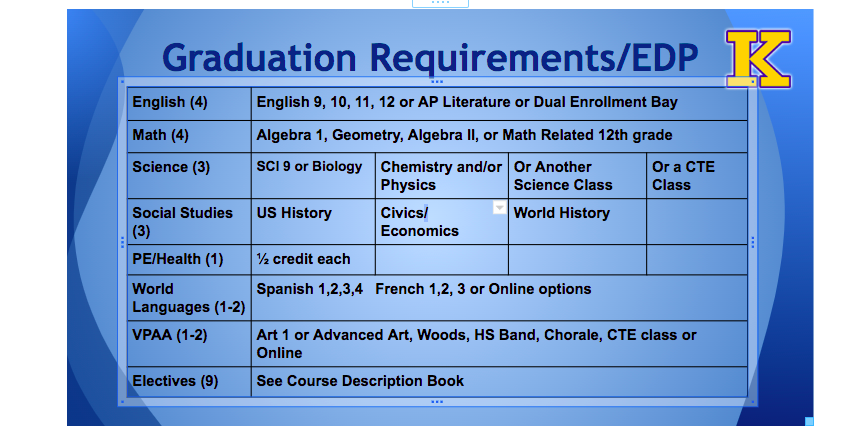
You need 24 credits to graduate
|
You earn credits by passing your Q1 + Q2 + Final Exam = Semester 1 grade.
(Q1)40% + (Q2)40% + (Final)20% = (S1)100% So remember the 40-40-20 rule. What happens if I fail a required course (S1 or S2)? You will be placed on a credit recovery plan. This may include Summer School. Summer School is offered Mon - Thurs for 4 weeks. Need to attend from 8-10am to make up .5 credit or 8-12 to make up 1 credit. |
New or Returning Classes for 2024-2025
- Intro to Computers - This course provides you with an overview of basic computer skills you need to be successful now and in the future. Many students think they "know computers," but do they really? Help improve your academics and your opportunities for future success by becoming familiar with all the ways technology can be used to your benefit. (Pending Board Approval)
- Spanish Cultures and Language - This course is pending School Board approval. When it is approved, it will be a course primarily geared towards underclassmen, but could be available for upperclassmen who have had an unsuccessful attempt at passing a traditional World Language class (Spanish, French, or ASL). This class will be an exploration of various aspects of the Spanish culture. It will satisfy one World Language credit for graduation. (Pending Board Approval)
Dual Enrollment
- Registration for Fall 2024 courses at Bay College opens the first week of March.
- If you plan to take a Dual Enrollment class through Bay for the Fall Semester, please communicate the course on the course schedule form and complete the required paperwork for Bay College and KHS.
- The Michigan Transfer Agreement is a way for you to earn 30 credits of general education credits that will be accepted at most private and public colleges and universities in Michigan. If you complete your MTA, you will not need to take additional general ed credits in college. You can start taking classes in your major. This is an average savings of about $30,000. This MTA guide is a very helpful tool to plan out your courses.
- Please look at the courses on THIS DOCUMENT. It is a tentative list of the online course offerings for Dual Enrolled students through Bay College. You WILL still need to meet prerequisite requirements for MATH or ENGLISH depending on the course. See Mrs. Sutton for more information.
Are there tutoring options for me?
Teachers are by far your best resource and are available either before or after school. Aside from that option, we do have a volunteer tutoring program before and after school. Currently, the Study Lounge is available in the Media Center from 3:10:-4:00. No appointments needed.
What are AP courses?
AP stands for Advanced Placement. These courses are on a 5.0 grading scale. For example, an A would be worth a 5.0 rather than the 4.0 on the traditional scale. This is due to the college level of rigor in these courses. This is a great way for students to get a feel for a college classroom. In addition to added grade points, there is also a test given in May each year, in which universities will award credit for high scores. See the Counseling Office for more details. Currently KHS offers the following in-person AP classes:
AP Literature and Composition (Seniors only)
AP Computer Science Principles
AP Computer Science A
AP United States History
AP Calculus AB
AP Chemistry
AP Literature and Composition (Seniors only)
AP Computer Science Principles
AP Computer Science A
AP United States History
AP Calculus AB
AP Chemistry
What's an EDP?
An EDP is a working document that records students’ career goals and pathways to reach those goals. The State of Michigan Department of Education’s Public Act 209 of 2014 “requires districts to provide students an opportunity to develop an Educational Development Plan (EDP)” and for parents/guardians to “review and endorse” this EDP.
Career Cruising
Step #1 - Update Career Cruising to reflect your current post-high school plans. Choose at least three potential career interests and choose SAVE TO EDP.
Step #2 - Update your Education Plan to include the classes you are currently enrolled in and what you intend to take next year, and maybe the year after that, too.
Step #3 - Click on the progress bar and complete the tasks generated for you
Step #4 - Try to move the progress bar in Career Cruising to 50% before the end of the school year.
Step #2 - Update your Education Plan to include the classes you are currently enrolled in and what you intend to take next year, and maybe the year after that, too.
Step #3 - Click on the progress bar and complete the tasks generated for you
Step #4 - Try to move the progress bar in Career Cruising to 50% before the end of the school year.
What's in an EDP?
- Personal Information for identification : Name, grade, address, etc.
- Career Goal(s): Each student should identify a career pathway and goals for achieving success. These may be more general in middle school and become more specific as the student progresses through high school.
- Educational/Training Goal(s): Each student should identify the level of educational preparation that will be needed to meet his or her career goal. This encourages the student to think beyond high school graduation and to set long-range goals.
- Assessment Results: Students will record their interest inventory results to help guide career planning.
- Plan(s) of Action: The action plan should include career awareness or exploration activities with course selections that will prepare the student for greater understanding of career options and achievement of career goals.
- Parent Consultation/Endorsement: Parents/guardians should have the opportunity to review and endorse their child’s EDP. This will give parents access to information about emerging careers and employment trends so they can help their children prepare for the future. Parents/guardians may also need to discuss assessment results and may need assistance with interpreting them. Students should be encouraged to discuss career-related issues with their parents and share their goals and action plans.
High school scheduling terminology
Advanced Placement: AP courses are university level courses offered on campus at Kingsford High School. Courses which are designated as “AP” on a student’s transcript will have a 5.0 grading scale applied. Students who take the AP College Board test at the end of the course and score in a high enough range can earn college credit.
Dual Enrollment: Students in 10th, 11th, and 12th grades can take courses through Bay College during their school day and earn college credit that might be transferable to other colleges or universities. These courses are paid for by the school district.
Early Middle College (EMC): In the spring of their sophomore year, or the fall of their junior year, students can enroll in the Early Middle College program that can set them on the path to earn a certificate in Welding, Clinical Nursing Assistant, Mechatronics, or an Associates Degree in Mechatronics, Pre-Engineering, Cyber Security, or Computer Network Information Systems. Many of these programs transfer seamlessly to other colleges or universities. Students who are part of the EMC delay receiving their diploma for a year (they still participate in graduation with their class, though) then attend Bay College for a year after graduation to receive their degree or certificate. This is all paid for by the school district.
Educational Development Plan (EDP): An EDP is a working document that records students’ career goals and pathways to reach those goals. This EDP is used to help students, parents, and counselors ensure a student is taking the right courses and making the right plans to meet the student's after high school college or career goals. At KHS, we use Career Cruising to document students' EDP's.
Visual, Performing, or Applied Arts (VPAA): The goal of the visual, performing, and applied arts credit guidelines is to ensure that all students have a foundation and experience in the complete artistic/creative process, and they achieve competence in the process by the time they graduate from high school.
Work Based Learning: Students in 11th and 12th grade can earn work experience and on-the-job training during the school day in a variety of work environments throughout Dickinson County. Students must apply to the Work Based Learning program. Certain criteria must be met to take part in this program, including ensuring the placement matches specifically the students' career interests on their EDP.
Dual Enrollment: Students in 10th, 11th, and 12th grades can take courses through Bay College during their school day and earn college credit that might be transferable to other colleges or universities. These courses are paid for by the school district.
Early Middle College (EMC): In the spring of their sophomore year, or the fall of their junior year, students can enroll in the Early Middle College program that can set them on the path to earn a certificate in Welding, Clinical Nursing Assistant, Mechatronics, or an Associates Degree in Mechatronics, Pre-Engineering, Cyber Security, or Computer Network Information Systems. Many of these programs transfer seamlessly to other colleges or universities. Students who are part of the EMC delay receiving their diploma for a year (they still participate in graduation with their class, though) then attend Bay College for a year after graduation to receive their degree or certificate. This is all paid for by the school district.
Educational Development Plan (EDP): An EDP is a working document that records students’ career goals and pathways to reach those goals. This EDP is used to help students, parents, and counselors ensure a student is taking the right courses and making the right plans to meet the student's after high school college or career goals. At KHS, we use Career Cruising to document students' EDP's.
Visual, Performing, or Applied Arts (VPAA): The goal of the visual, performing, and applied arts credit guidelines is to ensure that all students have a foundation and experience in the complete artistic/creative process, and they achieve competence in the process by the time they graduate from high school.
Work Based Learning: Students in 11th and 12th grade can earn work experience and on-the-job training during the school day in a variety of work environments throughout Dickinson County. Students must apply to the Work Based Learning program. Certain criteria must be met to take part in this program, including ensuring the placement matches specifically the students' career interests on their EDP.
